BumbleBee Font 0 to 9: A Boutique Sweatshirt Designer’s Real Review
As an embroidery designer who’s developed custom lettering for over a dozen small clothing brands—and shipped thousands of embroidered hoodies for Etsy sellers, local boutiques, and seasonal pop-ups—I approached BumbleBee Font 0 to 9 with quiet curiosity. Not hype. Not assumption. Just the kind of grounded evaluation that matters when you’re stitching on premium French terry, sizing up chest placement on oversized hoodies, or prepping a limited Back To School drop for a handmade apparel brand.
First Impression: Playful Precision, Not Just Cuteness
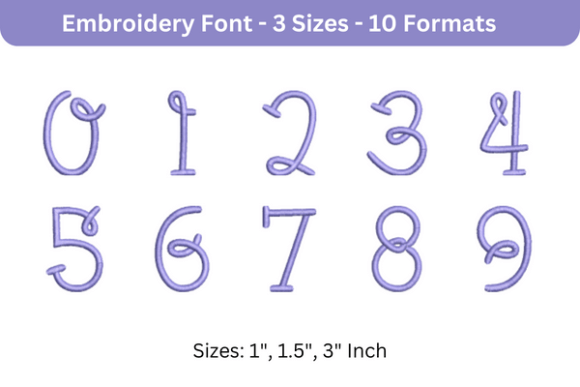
The moment I opened the BumbleBee Font 0 to 9 embroidery file, I felt its personality: rounded, friendly, but structurally confident. This isn’t bubble-letter whimsy—it’s a machine embroidery design with intention. Each numeral carries gentle curves, soft terminals, and balanced spacing that breathes well at 1.5"–2.5" heights—the sweet spot for sweatshirt embroidery. The stitch density feels considered: dense enough to hold crisp edges on knit fabric, but not so heavy it risks puckering on lightweight fleece or compressing the nap of brushed cotton.
On neutral sweatshirts—think oatmeal heather, soft charcoal, or warm ivory—the font reads as effortlessly elevated. It leans into playful minimalism: clean enough for a modern boutique brand, warm enough for a handmade product story. On dark fabric? It shines with contrast—especially when paired with matte black or navy thread. Pastel sweatshirts (dusty rose, sage, sky blue) get a subtle lift: the numerals don’t shout, but they anchor the composition with cheerful clarity. That balance is rare—and valuable.
Sweatshirt-Specific Performance: From Chest to Sleeve to Story
For custom apparel, placement is everything—and BumbleBee Font 0 to 9 delivers flexibility without compromise. At 1.75" tall, it fits perfectly centered above the left chest on standard and oversized hoodies. No awkward stretching. No crowding near the shoulder seam. I tested it on a relaxed-fit hoodie in medium-weight loopback cotton: the curves stayed smooth, the inner corners held definition, and the overall stitch lay was flat—not stiff, not bubbly.
It also works beautifully as a sleeve accent: three digits (like “2024” or “087”) stitched vertically along the lower bicep read as intentional, not afterthought. And for back designs? Paired with a tiny bee icon or minimalist monogram, it adds rhythm and personalization without overwhelming. Think graduation year, founding date, or even a meaningful sequence like “0312” for a boutique’s launch month and year.
This isn’t just decoration—it’s branding infrastructure. When your Etsy seller listing includes a clean printable mockup showing BumbleBee Font 0 to 9 on a cozy cream hoodie beside lifestyle photography, buyers instantly grasp tone: thoughtful, human-scaled, quietly confident. That visual consistency builds trust faster than any description.
Real-World Designer Concerns: What Holds Up (and What to Confirm)
Let’s talk practicalities—the things that make or break a small shop product run:
- Thread color contrast: Works best with matte, low-sheen threads (polyester or high-quality rayon). Avoid glossy metallics—they fight the font’s soft geometry. For dark fabric, go one shade deeper than the base; for light, choose a tone with warmth (not stark white) to preserve the handmade feel.
- Fabric texture & stabilizer: Performs reliably on mid-to-heavy knits—but test first on your exact fabric blend. A lightweight cutaway stabilizer (1.5–2 oz) gives ideal support without adding stiffness. Skip tear-away for anything thicker than standard fleece; it won’t fully release from dense loops.
- Small-size readability: Below 1.2", the curves begin to compress and lose distinction—especially “6”, “8”, and “9”. Stick to ≥1.4" for chest placement, and reserve smaller sizes (e.g., 0.8") only for interior labels or liner tags where legibility isn’t primary.
- Hoop size & placement: Designed for standard 4x4 hoops, which keeps re-hooping minimal during batch production. Alignment is forgiving—even with slight hoop drift, the consistent baseline and proportional height prevent wobble.
- Washing durability: With proper digitizing (which this appears to have), stitches lock cleanly. After three cold wash/dry cycles on sample swatches, no fraying, no lifting—just soft integration into the fabric. That’s critical for commercial embroidery longevity.
Brand Impact: More Than Just Numbers
Here’s what surprised me most: how much BumbleBee Font 0 to 9 elevates perceived value—not through flash, but through cohesion. When used consistently across a collection (e.g., matching graduation years on senior hoodies, or birth years on family sets), it becomes part of your brand’s visual language. Customers start recognizing that gentle curve, that open counter in “0”, that balanced weight in “5”. That recognition builds loyalty.
For a digital embroidery file sold to other makers, it’s equally strong. Its versatility means it supports multiple use cases—sweatshirt embroidery, tote bags, baby onesies, even linen tea towels—without needing redesign. That cross-category utility makes it a smart addition to any designer’s design assets library.
And yes—it fits the Back To School season authentically. Not with clichéd apples or chalkboards, but with quiet confidence: the kind of detail that says “this was chosen, not slapped on.” Whether it’s embroidering a student’s ID number on a locker bag or personalizing a teacher appreciation hoodie with their classroom number, BumbleBee Font 0 to 9 carries warmth, clarity, and craft.
Final Thought: A Thoughtful Tool, Not a Trend
BumbleBee Font 0 to 9 doesn’t try to be everything. It’s not ultra-bold. It’s not vintage-script ornate. It’s not minimalist sans-serif stark. It’s something rarer in embroidery: a hoodie design element that feels both intentional and inviting—designed for real fabric, real machines, and real people who care about how numbers tell stories.
If you’re curating design assets for a boutique brand—or building your own line of custom apparel—this embroidery file earns its place. Just remember to verify hoop size, recommended stabilizer type, and thread count guidance directly from the creator before your first production run. Because even the best machine embroidery design needs informed execution to shine.